OnMyWay
Project Type
Personal Project
Role
Ideation & Prototyping
Goal
A personal mobility assistant that smartly combines transport modes and real-time constraints into one seamless experience.
Results
A smart app that plans cost-effective, real-life journeys by combining transport modes and personal routines
My Contribution
Solo ideation and prototyping for a smart mobility app that combines transport modes and real-time constraints.
Which Tools
Figma

Description
I worked solo on Ideation and prototyping for OnMyWay, a smart mobility app designed to simplify urban travel. The goal was to create a personal mobility assistant that seamlessly combines public transport, car sharing, and real-time constraints to make daily journeys easier, faster, and more cost-effective.

The Problem Statement
1. Existing Maps Apps Are Limited
- Google Maps and Apple Maps only allow multi-stop planning if you are driving a car.
- If you want to use public transport plus another mode (like bike, scooter, or car sharing), the apps simply do not support it. You are forced to stitch routes together manually.
2. Real Life Is Messy
- In cities like Berlin, car sharing services (for example MILES) let you pick up and park a car anywhere. But driving the whole way from A to C is often too expensive.
- Imagine if the app could calculate a hybrid route for you:
- Take a quick bus ride from A to B.
- From B, grab a nearby MILES car to finish the trip to C.
- You still arrive on time, but at half the price of driving a car the entire distance.
- Current apps do not give you this flexibility. You either overspend on convenience or risk being late with public transport alone.
Stage & Scope
Currently in the ideation phase. An interactive prototype has been created to demonstrate concept and key flows. Usability testing has not yet taken place. Work now focuses on exploring the technical and backend path to build a real application.
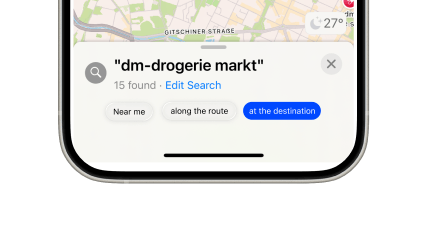
The Core Feature of OnMyWay
OnMyWay is not just about getting from A to B. It is about planning the journeys you actually live with all the little detours, errands, and personal routines along the way.
WHAT MAKES IT DIFFERENT
- Smart Hybrid Journeys: Combine public transport, car sharing, biking, and walking into one optimized trip. Not just the fastest route, but the smartest one for your situation.
- Personalized Detours: Build in the real-life stops you need without losing time.
SCENARIOS
1. Save Money with Smarter Combos
- Example: In Berlin, driving a car sharing service (like MILES) all the way is expensive.
- OnMyWay suggests: bus from A to B, then pick up a nearby MILES car from B to C.
- Result: You are still on time, but you pay 50% less than driving the whole way.
2. Errands on the Go
- You are heading to a friend's dinner, running late, and need to pick up a bottle of wine.
- OnMyWay calculates:
- Which train to take.
- The best stop with a supermarket directly on your route.
- The time buffer you will have to grab the wine and still make it on time.
- No app today can do this. You would normally have to guess and stress.
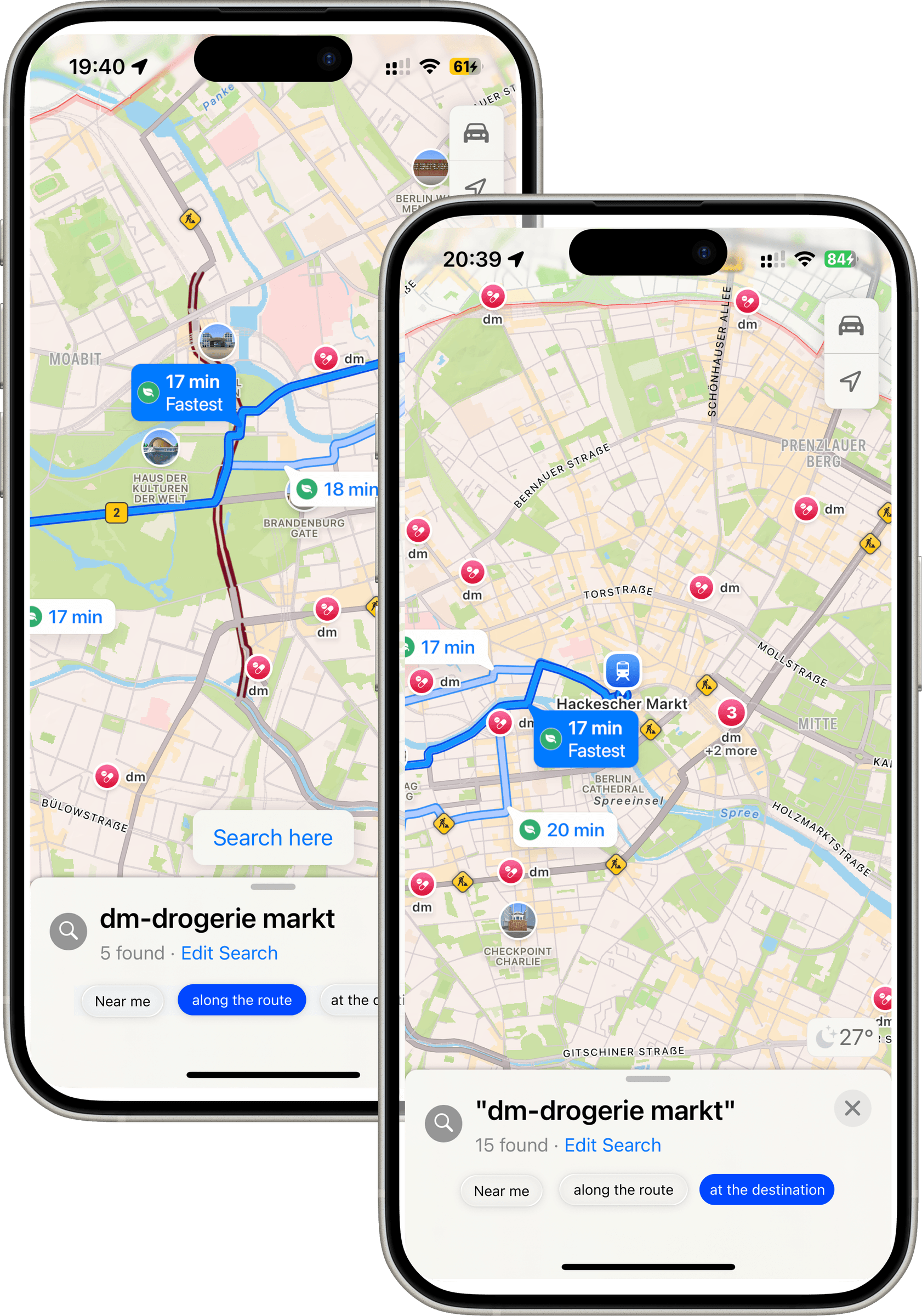
3. Life Along Your Commute
- You have just moved to a new city. You take the U2 line daily to work.
- OnMyWay lets you search along your existing route:
- "Find me fitness studios near my U2 commute."
- Instead of blindly searching maps and trying to guess what is convenient, the app finds places that fit seamlessly into your daily rhythm.
WHY THIS IS POWERFUL
- Current apps only show you routes or destinations, never both in harmony.
- OnMyWay is the first to say: your journey is more than transport. It is errands, routines, and time pressure, all balanced automatically.
- It saves money, removes stress, and makes daily life smoother by planning for reality, not theory.
Current Focus
- Backend Exploration:
- Transport APIs (train and bus schedules, delays).
- Car sharing services (availability, pricing).
- Real-time traffic and map data.
- Architecture Questions: How to calculate routes that intelligently mix these data sources.
- Preparing the groundwork for an MVP that can run in one city (for example Berlin) as a proof of concept.
Reflection & Next Steps
- The prototype already demonstrates the value proposition: reliable and cost-smart mobility planning.
- Next step: align technical feasibility (API integrations and backend logic) with the prototype to move toward a working MVP.
- Longer term: expand to other cities and integrate additional mobility services.